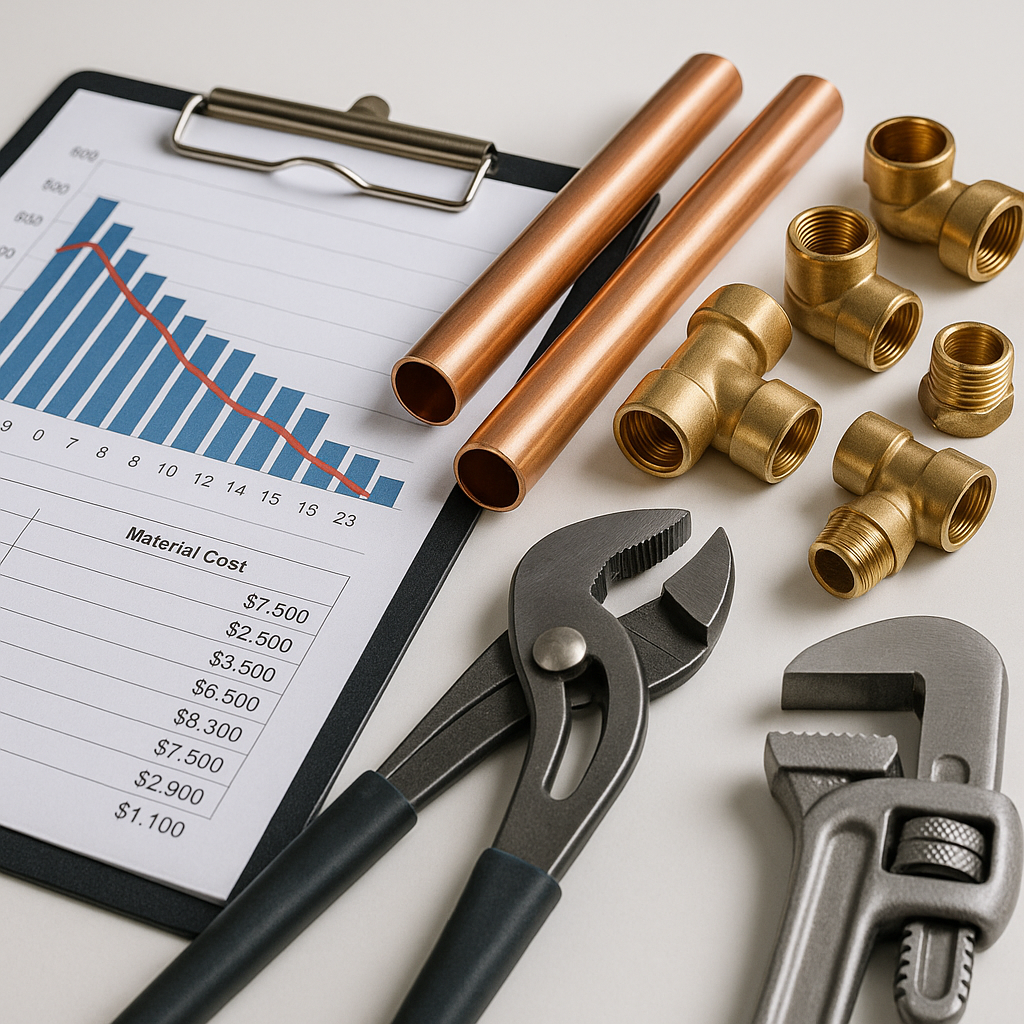
For many UK trade businesses, small pricing mistakes do not feel urgent. A valve is a few pounds out, a fitting has not been updated since spring, or an engineer picks an older item from the ServiceM8 list. On one job, it may not look like a big deal. Across a full month of plumbing, heating, HVAC or electrical work, it can quietly chip away at profit.
That is why incorrect material prices are more than an admin problem. They directly affect job margins, quoting accuracy and cash flow.
As September gets underway, many plumbing and heating firms are preparing for the autumn and winter rush. Supplier prices can change quickly at this time of year, especially for heating-related materials and fast-moving stock. If your pricing is not current before demand picks up, your margins can take a hit just when you need them most.
Why material price errors matter more than most owners think
Most trade business owners keep an eye on labour, scheduling and overheads. Material pricing often gets less attention because each individual error looks small.
The problem is that margins are usually lost in bits, not all at once.
If your team is quoting or invoicing with the wrong material prices in ServiceM8, a few things happen:
- estimates are based on outdated costs n- selling prices do not reflect current supplier increases
- engineers and office staff may use different item prices
- markup becomes inconsistent across jobs
- higher-volume items create repeated losses over time
For a plumbing business, this can be especially damaging. Common items such as copper fittings, valves, pumps, controls and cylinders can move in price over the year. If those changes are not reflected in your system, you may still be winning jobs while earning less from each one.
How the damage shows up in real jobs
Incorrect prices rarely announce themselves clearly. They usually appear as jobs that felt busy but did not leave much profit behind.
Your quotes look profitable on paper
A quote can appear healthy when it is built, but if the material costs behind it are old, the expected margin is not real. You are effectively pricing work on last season's numbers.
This is one reason why accurate material costs matter when quoting jobs. If the base cost is wrong, your markup and final sell price will also be wrong.
Small errors multiply across repeated work
Say a part is underpriced by £3.50. On one job, that may not seem serious. If that same item is used on 60 or 80 jobs over a couple of months, the total loss becomes meaningful.
This is how small pricing errors add up across hundreds of jobs. The issue is not just the size of one mistake, it is how often the same mistake is repeated.
Engineers use different versions of the same item
When inventories are not maintained properly, teams can end up with duplicate or near-duplicate items. One version may have the latest price, while another still carries an older value.
That creates inconsistency. Two engineers can use what appears to be the same material but charge different amounts, which makes reporting, costing and margin control much harder.
The most common causes of incorrect prices in ServiceM8
If you use ServiceM8 for inventory and job materials, price issues usually come from process problems rather than the platform itself.
Here are some of the most common causes:
- supplier price lists are updated, but your ServiceM8 items are not
- your business has no single master price list
- old items stay in the system alongside newer ones
- product names and codes are inconsistent
- office staff update prices manually, one by one
- engineers add ad hoc items during busy periods
- nobody is fully responsible for reviewing pricing data
This is why many growing firms start looking at a master list in Google Sheets or another central source. It gives the business one version of the truth, rather than relying on scattered updates.
How to protect your job margins
You do not need a complicated system. You need a reliable one.
Create one source of truth for prices
Your team should not be checking supplier emails, old spreadsheets and ServiceM8 at the same time. Keep one central price list for product codes, descriptions, cost prices and selling prices.
For many smaller and medium-sized trade businesses, Google Sheets is still a practical option because it is simple, flexible and easy to review.
Standardise your item naming
If the same item appears under slightly different names, duplicates become much more likely. Use a clear naming format and standard product codes across the business.
This helps your office team maintain cleaner records and makes it easier for engineers to choose the correct item on jobs.
Review seasonal products before demand rises
Autumn is a good time to check high-use heating and plumbing items before winter workload increases. If your company handles boilers, controls, pumps, radiators or hot water components across the UK, review those items now rather than waiting until the diary is full.
A short pre-season review can prevent margin leaks during your busiest period.
Reduce manual updating where possible
Manually changing prices item by item is time-consuming, and it makes missed updates more likely. If your inventory is large, the process becomes harder to manage as the business grows.
This is where tools built for ServiceM8 users can help simplify price management without changing your existing workflow.
A better approach for ServiceM8 users
MaterialM8 is designed for trade businesses that want tighter control over inventory pricing in ServiceM8. Instead of relying on scattered manual changes, you can manage your material data from a central source and keep prices more consistent.
If you are exploring better ways to organise pricing, it is worth looking at Materialm8. It can also help to start with the main Materialm8 homepage if you want an overview of how it fits into a ServiceM8 workflow.
The goal is simple. Save admin time, reduce pricing mistakes and protect margins across every job.
Final thought
Incorrect material prices do not just create messy admin. They can quietly erode the profit on every job your team completes. For plumbing and heating businesses going into a busy autumn period, that risk is even more important to address now.
If your quotes, invoices and inventory items are not all working from the same up-to-date prices, your margins may already be under pressure.
If you want a simpler way to stay on top of ServiceM8 material pricing, visit Materialm8 and see how MaterialM8 helps trade businesses keep control of their price lists.