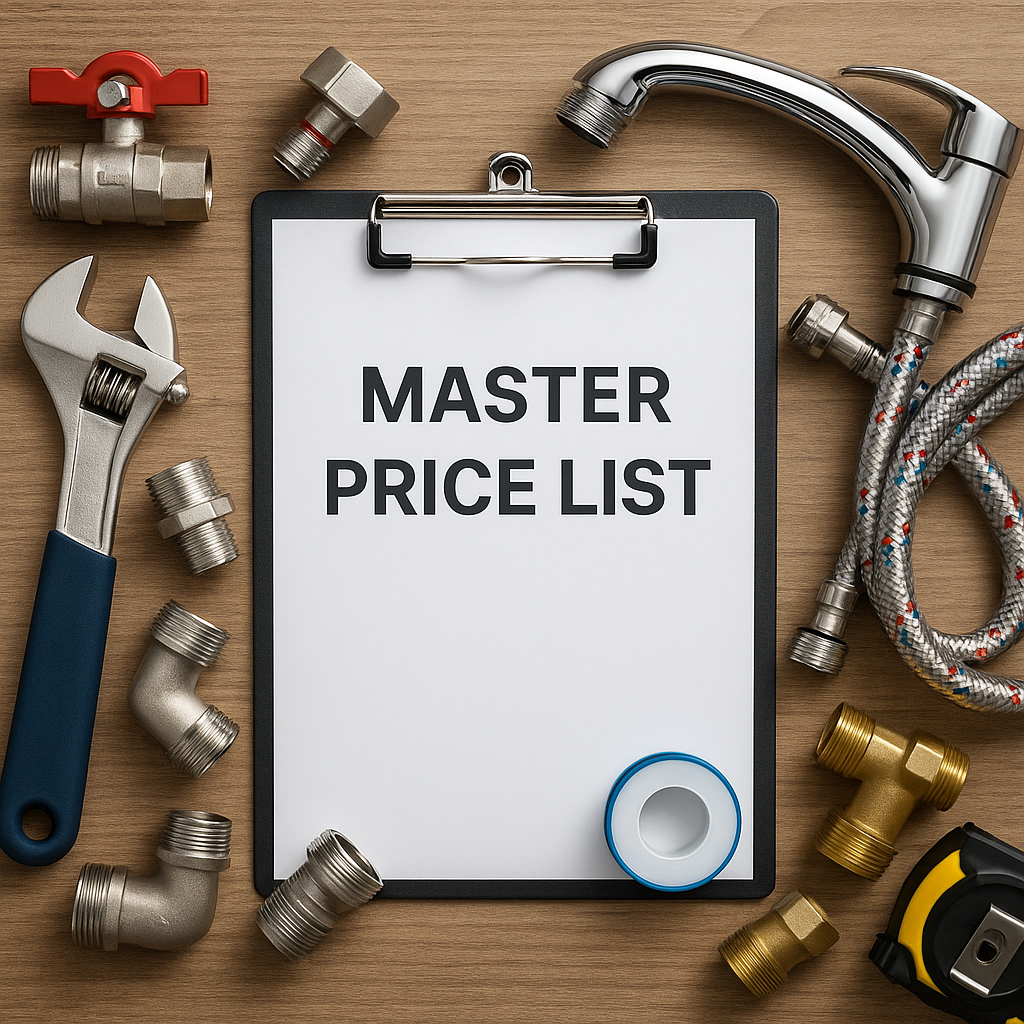
If you run a plumbing and heating business in the UK, September is often when pricing problems start to show up more clearly. As colder weather approaches, quote volumes rise, heating jobs increase, and more materials move through the business. That is exactly when inconsistent pricing can create delays, confusion and reduced margins.
A master price list gives your business one reliable place for material costs, selling prices, product codes and item names. Instead of engineers, office staff and managers all working from slightly different information, everyone uses the same source of truth.
For plumbing and heating companies using ServiceM8, this matters even more. If your inventory is not consistent, it becomes much harder to quote accurately, update prices properly and keep control of job costing.
What a master price list actually is
A master price list is a central record of the materials and parts your business buys and sells regularly. In most cases, it includes:
- product name
- supplier code or SKU
- your internal item name
- cost price
- selling price
- VAT treatment, where relevant
- category or trade type
- notes on pack size or unit of measure
This list is not just an admin document. It is the foundation for consistent pricing across your whole business.
For many trade firms, Google Sheets works well as the place to manage that list, especially if prices change regularly and more than one person needs access. From there, the data can be pushed into operational systems such as ServiceM8.
Why plumbing and heating businesses struggle without one
Plumbing and heating companies often carry a wide mix of stock and non-stock items. You may have boilers, valves, pumps, controls, copper fittings, plastic fittings, radiators, flue components and consumables all priced differently, often from multiple suppliers.
Without a master price list, a few common problems appear quickly.
Different people use different prices
Your office team may quote one figure, while an engineer on site adds the same item at a different rate. That creates inconsistency for customers and confusion inside the business.
Similar items get entered more than once
One person writes “22mm copper elbow”, another enters “Copper Elbow 22mm”, and someone else uses a supplier code. Now you have duplicate items, and no clear idea which one carries the correct price.
Supplier increases are harder to apply
When manufacturers and merchants change their prices, you need to update your figures quickly. If your pricing data lives across emails, old spreadsheets and ad hoc ServiceM8 entries, updates take longer and mistakes are more likely.
Job costing becomes less reliable
If material prices are inconsistent, your reports are less useful. You might think certain jobs are profitable when in reality your margins are being chipped away by inaccurate item pricing.
The practical benefits of a master price list
A proper master price list helps with more than just tidy admin. It improves day to day operations in ways that save time and reduce avoidable errors.
Faster quoting during the busy heating season
Autumn and winter are busy periods for plumbing and heating firms across the UK. When breakdowns, replacements and heating upgrades increase, your team needs to quote quickly. A central list means less time checking old invoices, supplier portals or past jobs.
Better consistency across engineers and office staff
When everyone uses the same item names, codes and prices, there is far less back and forth. This is especially useful if you have multiple engineers adding materials to jobs in ServiceM8.
Easier stock and inventory management
If you want to organise your ServiceM8 inventory properly, you first need clean source data. A master list helps standardise naming, reduce duplicates and make future updates more straightforward.
Stronger control over margins
A master price list makes it easier to review whether your current selling prices still reflect supplier costs and your intended markup. That does not mean changing prices constantly, but it does mean making decisions based on accurate information.
What should be included in your pricing system
If you are building or improving your price list, keep it simple and practical. Start with the items you use most often, then expand.
A good setup usually includes:
- One agreed product name for each item
- One product code or SKU for matching purposes
- A clear cost price
- A standard selling price
- A category, such as boilers, heating controls or fittings
- Notes for unit size, pack quantity or common alternatives
If possible, avoid letting every team member create new item names freely. That is one of the main reasons ServiceM8 inventories become cluttered over time.
Why this matters in ServiceM8
ServiceM8 is excellent for running jobs and managing field operations, but the quality of your inventory depends on the quality of the data going into it. If your plumbing business does not have a master list behind the scenes, ServiceM8 can end up holding inconsistent item names, duplicate entries and old prices.
That is why many firms choose to manage their central product data outside ServiceM8, then keep ServiceM8 aligned with that list.
MaterialM8 is built around that exact problem. It helps ServiceM8 users keep pricing and inventory data more controlled without having to change how the rest of the business works. If you want to understand the wider approach, you can start with Materialm8.
How to get started without overcomplicating it
You do not need to rebuild your entire system in one go. Start small and focus on repeat-use items.
A sensible approach is:
- export or review your current ServiceM8 inventory
- identify your top 100 to 300 commonly used items
- choose one naming format
- add product codes or SKUs consistently
- confirm cost and selling prices
- keep the list in one shared location
- decide who is responsible for approving changes
This is often enough to create a much cleaner foundation. Once you have that, future updates become easier and your team spends less time fixing preventable mistakes.
Final thought
Every plumbing and heating company needs a master price list because pricing consistency is not just an office issue. It affects quoting speed, engineer accuracy, inventory quality and confidence in your margins.
As the colder months approach and workload increases, now is a smart time to get your pricing data under control. If you use ServiceM8 and want a simpler way to manage inventory pricing from one central source, take a look at Materialm8 and see how it can support a cleaner, more reliable setup.