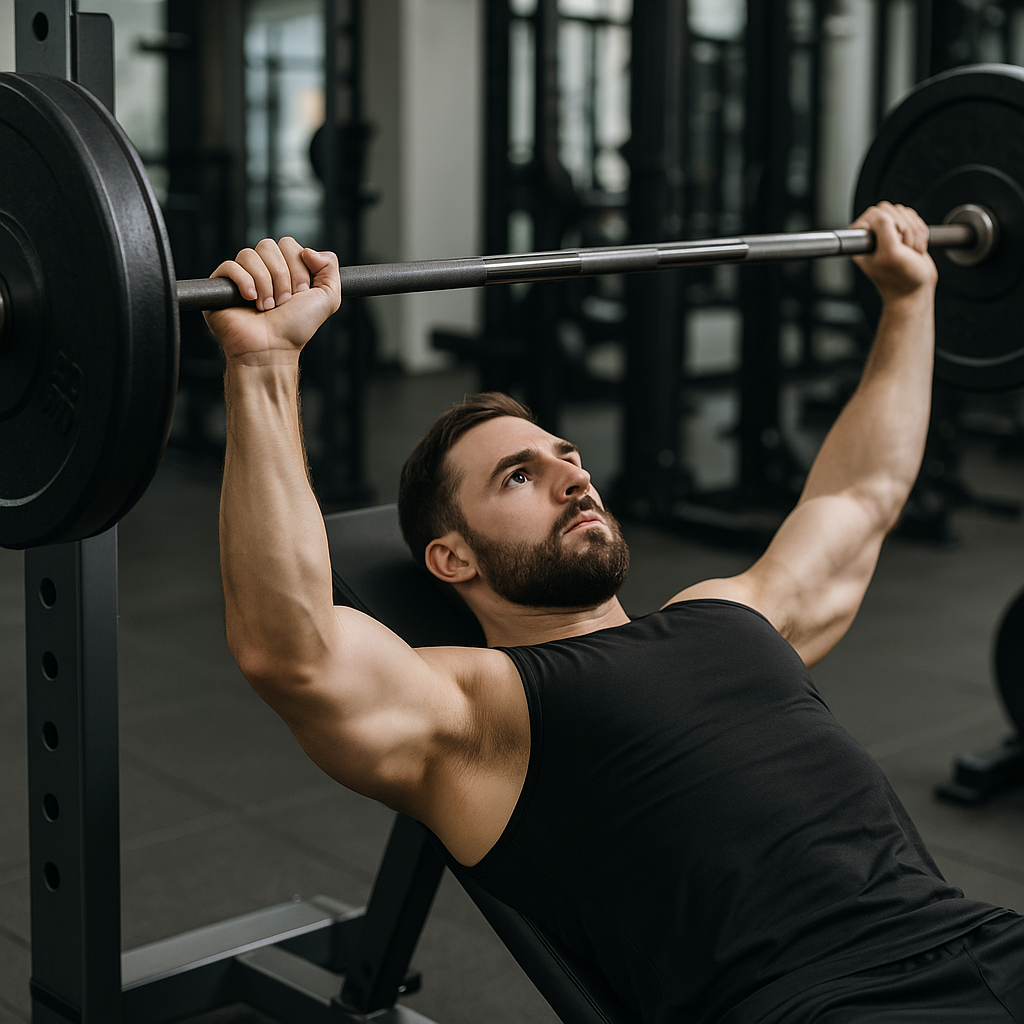
Summer brings a different kind of challenge in the gym. In July, routines get knocked about by holidays, hot nights and broken sleep. That is exactly when lifters start cutting corners, especially on the lowering phase of a lift. The bar drops too fast, positions get sloppy, and joints end up taking stress that the muscles should be handling.
If you are serious about strength, size and staying in the game, learning to control the eccentric matters. Proper form prevents gym injuries, and one of the biggest ways to prove that is by owning every inch of the rep, not just the part where you drive the weight up.
At The Muscle Pit, Venice Beach Dewsbury, Old-School 24/7 Gym, serious lifters know the job is not just to move weight. The job is to move it properly, consistently and under control.
What the eccentric actually is, and why it matters
The eccentric is the lowering part of the movement. On a bench press, it is bringing the bar down to the chest. On a squat, it is the descent into the hole. On a row, it is letting the weight travel back out instead of simply dropping it.
A lot of lifters focus only on the hard, aggressive part of the rep. That is fine if your goal is to look busy. It is useless if your goal is long-term progress.
Controlled eccentrics help with:
- better position under load
- cleaner bar path
- more tension through the target muscle
- less sudden stress on joints and connective tissue
- stronger technique carry-over to heavier sets
If your descent is wild, your press, squat or pull is already compromised before the hard part begins. In a serious training environment, especially in a proper old-school gym in Dewsbury, that sort of lazy lifting gets found out fast.
Why lifters get injured when they rush the lowering phase
Injury does not always come from one dramatic bad rep. A lot of the time, it comes from repeated sloppy reps done week after week. Summer can make that worse because people are often training around travel, family plans and disrupted recovery.
Gravity is not your training partner
Letting gravity take over is not the same as training hard. When you dive-bomb a squat or crash a bar into your chest, you lose tension and put more strain on passive structures. That means shoulders, elbows, knees and lower back can take a beating they do not need.
Fast reps hide weak positions
If you cannot control the descent, there is a good chance you are covering up weak bracing, poor shoulder position or a lack of control through the hips. Slowing the rep down just enough exposes those issues early, before they turn into proper pain.
That is where proper form prevents gym injuries in real-world training. It is not about lifting like a robot. It is about controlling the weight well enough that your body stays in the right place under pressure.
Where controlled eccentrics make the biggest difference
Not every lift needs the same tempo, but nearly every serious movement benefits from a deliberate lowering phase.
Bench press
A controlled descent helps you keep your upper back tight, elbows better positioned and the bar path cleaner. If you drop the bar too quickly, you lose tightness and invite shoulder irritation.
Squat
On squats, control on the way down helps you keep your brace, track your knees properly and hit depth without collapsing. Rushing the descent often leads to loose positions and ugly compensations.
Romanian deadlifts and rows
These lifts are brutal teachers. If you let the weight fall, you lose tension in the hamstrings, lats and upper back. Control the negative and the target muscles do the work they are meant to do.
Machines and accessory work
Old-school bodybuilding was built on making muscles work, not just moving stacks. On cable work, leg curls, chest-supported rows and similar movements, a controlled eccentric can be the difference between actual hypertrophy and wasted reps.
How to use eccentrics without overcomplicating training
You do not need to count to five on every rep for the rest of your life. The goal is not drama. The goal is control.
Use this simple approach:
- Lower the weight with intent, usually around two to three seconds.
- Keep the same body position on the way down that you want on the way up.
- Stay tight in the bottom, do not switch off.
- Drive up hard once you are in control.
- If you cannot lower it properly, the weight is probably too heavy for that set.
This works especially well in a 24/7 gym setting where people train at all hours. Late-night and early-morning sessions can be productive, but only if discipline stays high when energy is lower.
Why this matters for strength and hypertrophy
Some lifters hear “control the eccentric” and assume it means going light. That is nonsense. Some of the strongest and biggest lifters in any hardcore gym environment understand that tight reps build reliable power.
For strength training, controlled eccentrics improve consistency. You get better at finding the same groove every rep, every set. That makes heavy attempts safer and more repeatable.
For hypertrophy, the muscles stay under useful tension for longer. That means better quality work, especially on accessory lifts and bodybuilding-focused sessions.
In both cases, proper form prevents gym injuries because the body is not being thrown into bad positions under load. That is what matters if you want to keep progressing through summer and beyond.
Train like you mean it in Dewsbury this July
In July, plenty of people drift. Sessions become rushed, form gets loose, and little aches start showing up. Serious lifters do the opposite. They tighten standards, stick to disciplined training and make every rep count.
If you want a proper place to train in WF13 1LD, with a no-nonsense atmosphere built around real strength and physique work, have a look at The Muscle Pit. If you are after a hardcore 24/7 gym in Dewsbury where free weights, specialist kit and serious training still come first, you will feel right at home.
Ready to train in a place that respects proper lifting? Check out The Muscle Pit and get your membership sorted.